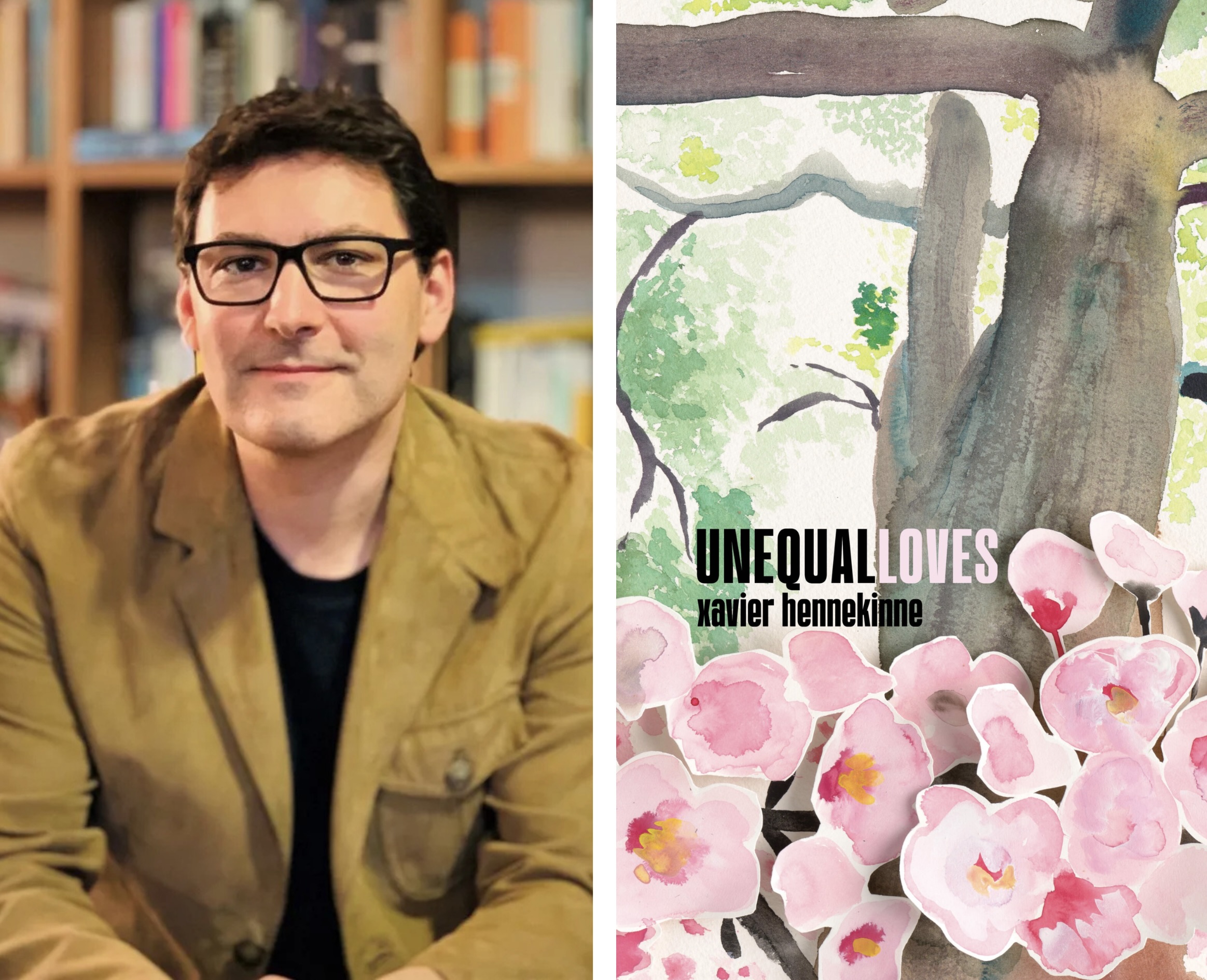
What drew you to translate Dreaming Out Loud by iconic French writer Lydie Salvayre?
I was kindly invited to do so by Xavier [Hennekinne]! I was honoured to work on a book by Lydie Salvayre, and drawn to the idea of revisiting Don Quixote. I liked the epistolary form of Rêver debout, though naturally, Cervantes never writes back. It was an invigorating book to translate. The sentences are often labyrinthine, the vocabulary elaborate. The word that comes to mind to describe the style is ‘magniloquent’, which is entirely consistent with the author’s project: she is addressing a great author from the 16th century.
I sometimes sensed the narrator getting into character, the way an actor might, for example gearing up to reproach Cervantes for bullying poor Quixote. One senses the author’s pleasure in writing; the whirl of language is inseparable from her great fervour in defending Quixote and the values he embodies. I feel that it’s a book that might stimulate lively exchange in a group of readers, or in a classroom.
What drew you to the art of translation in general?
It was a circuitous route. To start with, reading and writing have always been at the centre of my life, and I’ve loved books in translation since childhood. I studied French and Québécois literature at McGill University, in Montreal. On graduating, the work I found was in restaurants and that’s when I really started speaking French (I already read and wrote it without much difficulty). I trained to be an English as a Second Language teacher and did that for 10 years. I did not like teaching and so started looking for translation work, any I could find, some of which was very weird and wonderful. There was a film boom in Quebec at the time so I did quite a few scripts and subtitles, learning as I went. For years I worked in multiple domains, anything that came my way – medicine, cuisine, tourism, dance, sports, legal, new technologies, more film, a little fiction and memoir, etcetera. It’s only in the past 10 years that I’ve been doing literary translation as a main activity.
You are a writer as well as a translator. Do you find that these two vocations contrast or complement each other?
Writing and translation are complementary in many ways, but not, in my experience, in terms of time. Writing requires a different kind of energy from translation, a different pace – more stretches of idleness; daydreaming. I generally do one translation after another or more than one at a time. To write, now, would require a sabbatical year. Not to complain, though!
Translating is not unlike writing, but with more immediate perks. There isn’t the dread of the blank page that arises when you need to pull your own sentences out of nowhere. You are bound to the author’s original, given clear limits. Translation involves innumerable decisions that may be nerve-wracking, but less so than the ones you face while doing your own writing.
There is a feeling of movement and a satisfaction in translation, especially at the end of the process when the rhythm of English has started to infuse one’s rough transposition of the original words. Writing, even just daily notes, observations, events, letters, or a diary, nourishes translation, as does reading; translation could be described as a very slow and privileged form of reading.
Literary translation is a mysterious job to most. What is an ordinary day of work like for you?
Usually the first thing I do in the morning is leap into the translation I’m working on, and this is very heartening, whisking me past my dislike of waking up. In recent years, I have often worked on 3 or 4 translations in a given period – texts of varying length, type, difficulty. I do translation every day, mostly for 5 or 6 hours and sometimes an hour in the evening. It works out to about 35 hours a week.
If I’m just starting a translation, and I am in my home in Paris, and there are no pressing matters to deal with in life outside of translation, I work intensively for a few days to immerse myself in the voice of the book, familiarise myself with the sentence style and vocabulary, assess the difficulty and establish a schedule for the coming work. These orientation days are like little marathons. They are very important to the process.
As I advance in a translation, I make lists of the more tricky or mysterious words and expressions. Later I research them at leisure, and this can be very enjoyable. I sometimes make whole lists of possibilities in English from which to decide, and may keep changing a word or expression until the very end. Occasionally I’ll write to the author or ask a Francophone friend for clarification. But I usually try to figure things out for myself. Sometimes I jot down on a separate page my own impressions of a scene, or a phrase or an image, or note what comes up in my memory. These jottings can be a springboard for writing.
I alternate my ways of working, in order to rest the eyes and brain and get away from the screen: printing out pages and revising with bright-coloured markers. I sit on the couch and work on my lap, making free-form notes in a scribbler, as if doing maths problems. I open a window, stare at a piece of sky, contemplate. I used to work in cafés, even in the botanic garden down the street. But I’ve come to need silence when working on the harder passages, or in the final drafts as I read them aloud to test sonority: checking for bumpy sentences, jammed-up syllables, too many of the same consonants in a row, etcetera.
Some of the most effective solutions to a translation problem come when I am not sitting in front of the text. I’m sure this is true for many translators, writers and musicians. I have frequently worked out sentence rhythms while walking, doing housework, cooking, or lying in the dark at night – more’s the pity for my sleep.
What is the most challenging part of translating from the French, or does it vary from book to book?
It definitely varies from book to book. I often come across language challenges I’ve encountered before – sentence structure, turns of phrase, etcetera – and I can sometimes go back and look at another translation I’ve done, to see how I tackled the problem. But most of the time, I find that I have to start from scratch because the context is different each time, if only slightly.
If I’m looking for an expression or turn of phrase, an odd idiom, a literary reference, a historical fact, that kind of thing, naturally the internet is invaluable. There are a couple of translation forums from which I request and to which I contribute suggestions. These don’t always work out, but the contact is cheering and instructive.
In translating Salvayre’s book, I often consulted 2 or 3 English translations of Don Quixote, in the public domain and available online. This continually helped to refresh my sense of Quixote’s presence in Dreaming Out Loud, and specifically how it could be rendered in English. Consulting the translations also helped me find the English names and explanations of objects – like pieces of armour, or furniture – and titles, customs, and so on, that were antiquated or otherwise obscure. The dictionary suggestions weren’t always as relevant or interesting.
Translating titles can be self-evident, or very difficult, and everything in-between. With Dreaming Out Loud, it took quite a while, and several email exchanges with Xavier, to figure out a title that captures the book’s spirit without having to be a word-for-word transposition. (Rêver Debout literally means ‘dreaming standing up’.) Entire translation courses could be – maybe are? – taught on the subject of title translation.
Voice is the greatest challenge, though I am hard-put to say of what exactly it consists. Voice is the essence of the book. There is an internal logic to it; it has its own rules and rhythms. It is surprising how long it takes for the ‘click’ to arrive – for one to be able to say, ‘That’s the voice of the book’. Maybe it’s easier to judge through negation, i.e. ‘No, that is jarring, it’s inconsistent with the voice’. Even so, it can remain an elusive thing.
What is the most pleasurable part of translating from the French, or does it vary from book to book?
Most often the pleasures have to do with being inside an author’s voice for an extended period. Like other translators, I imagine, I have a strong relationship with this thing I call ‘voice’, which is at once palpable – for I am plunged into it day after day – and also, of course, abstract, as it is not something I literally hear.
You have received several honours for your work. Is there anything of which you are most proud, and why?
I felt very honoured, in 2019, to be awarded, with Annie Ernaux, The Warwick Prize for Women in Translation for The Years. It meant a great deal to me to receive a prize that honours women. Moreover, I hugely admire the endeavour it represents. A small jury reads dozens of works, translated into English from many languages – and not only the number of works considered, but the number of languages in which the books were originally written, seems to increase every year, which is wonderful.
Is there a book you hope to translate into the English, and why?
I don’t have one right now.
Favourite bookshop anywhere in the world?
I don’t have one at the moment.
What book are you currently reading?
Things in Nature Merely Grow by Yiyun Li, in audio (wonderfully read by the author). I very often read by audiobook as I have trouble with my eyes.
What’s the last book you read that you loved?
I love quite a few books and sometimes reread them, as I have just done with A Fairly Good Time by Mavis Gallant. I first read it, sneakily, under the cash counter of the secondhand bookstore where I worked, part-time, at age 16. I reread it every few years. It is a book to which I feel very close, for better and for worse.